
About
Symbiotic Design Framework
We help designers ethically transition from isolated, linear and conventional practices into systemic, dynamic and sustainable ones, reducing their environmental impact and achieving their social and economic goals on target.
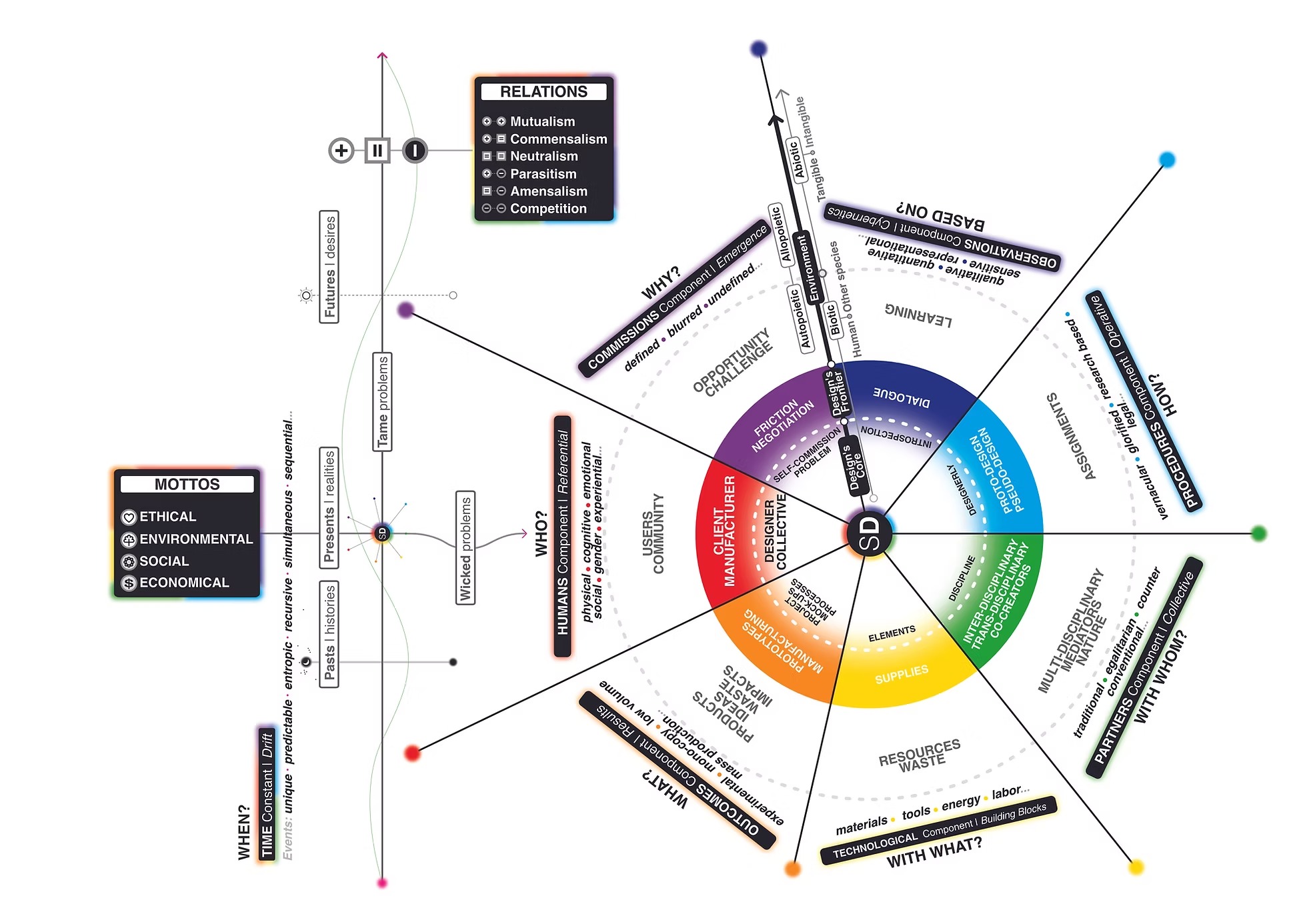
The Symbiotic Design Framework (SDF) did not emerge in isolation but rather as a rigorous synthesis of diverse theoretical constructs, historical analysis, and practical application designed to confront the complex reality of our time. It represents a necessary pivot from viewing design as a linear tool for industrial accumulation to seeing it as a medium for healing and regeneration. The framework's genesis lies in a deep dissatisfaction with the "Capitalocene," an era defined not merely by human impact, but by an economic logic that systematically cheapens nature and labor to fuel endless accumulation.
At its core, the SDF constitutes an intellectual rebellion against the "tame" problem-solving methods of the 20th century, which are woefully inadequate for the "wicked problems" of the 21st, such as climate breakdown and systemic inequality. The framework finds its theoretical backbone in the biological concept of Autopoiesis, or the capacity of a system to reproduce and maintain itself, pioneered by Chilean biologists Humberto Maturana and Francisco Varela. By applying this biological lens to design, the framework redefines the discipline not as a producer of objects, but as a living system responsible for its own "ethnoevolution" and ethical impact.
The journey of the SDF from a doctoral thesis to a globally applied methodology has been marked by continuous testing, refinement, and validation across a prestigious selection of academic and professional stages. This trajectory began with the foundational PhD thesis, "Autopoietic design," which identified the seven initial components, ranging from the Human and Relational to the Teleological, that now underpin the framework's structure. To uncover this initial illumination of design as an autopoietic instance, interviews and surveys were conducted with more than 360 licensed designers. Also an extensive literature review of around five hundred books was conducted.
The framework's academic rigor was stress-tested early on through various international presentations. In 2017, the foundational pedagogical concepts were explored in a comparison of Gropius and Buchanan published in Revista Base. By July 2018, its core propositions on "Sustainable Autopoietic Design" were presented at the Congreso Latinoamericano de Enseñanza del Diseño at the Universidad de Palermo in Buenos Aires. Later that year, the concept of autopoiesis as a sustainability formula was debated at the XIV Simposio Internacional del Posgrado en Artes y Diseño at UNAM in Mexico.
As the framework matured, its scope broadened to address social and ethical dimensions. In 2019, the author served as Guest Editor for a special issue of Design for All India focused on "Design & Misery," highlighting the unseen aspects of the discipline. By 2020, the framework had evolved to address the "Past, Present and Future of Design in Latin America" during an online symposium with CUMULUS members. That same year, the framework's "seven components for a sustainable future design model" were formally introduced to the global academic community at the Cumulus Rome 2020 conference. The adaptability of the framework was further demonstrated at CADi 2020 in Peru, where it was discussed in the context of "Reemergences" amidst global adversity.
However, the SDF was never intended to remain solely academic; it was built for the "Hic et Nunc," the here and now of professional practice. The transition from theory to tangible application accelerated significantly when the project was selected for an acceleration program in Valencia, Spain, supported by Next Generation EU funding. This validation on the world stage was pivotal. During the World Design Capital Valencia 2022, the framework was contrasted with the pluriversity of activities that were during this year long event. It was at this step that the Framework started shaping into its final stage.
Since then, the framework has matured through exposure at major European platforms. In April 2024, the Symbiotic Design Academy presented the "Symbiotic Design Framework Workshop" at the New European Bauhaus (NEB) Festival in Brussels, equipping the attendees with the mindset to integrate these concepts into design curricula. Following this, the framework was presented and refined at Dutch Design Week and Creative Skills Week, engagements that were instrumental in finalizing the methodology codified in the book Symbiotic Design Framework: Rethinking Design from within. During the last World Design Congress in London 2025 a paper that presents an abstract of the Framework in its totality was selected to be published in the proceedings.
The Framework has not been constructed in isolation, but it is the result of a continuous dialogue within the discipline.
The Academy and the Framework have been supported by, presented and tested at:











Dr Gonzalo Raineri
Father, husband, designer, architect, professor, design researcher and theorist based in Eindhoven, the Netherlands.

Dr. Gonzalo Raineri Bernain describes his professional life as a complex journey of "turning ideas into action" that has spanned nearly three decades. His career began with pragmatic humility, using his skills as an architect and designer to sustain himself, but eventually transformed into a vocation driven by witnessing the profound disconnect between conventional industry and the living systems of our planet. He writes with a refreshing lack of academic pretense, warning readers that his work is designed "to infect you with a dangerous optimism" regarding the potential for systemic change.
Dr. Raineri's perspective is informed by a truly nomadic and global engagement with design. His work and studies have taken him from the vibrant landscapes of Santiago, Chile, to Minneapolis, Amsterdam, Dublin, Madrid, Valencia, and currently, Eindhoven in the Netherlands. This international trajectory is underpinned by a formidable academic foundation, including degrees in Design and Architecture, followed by five postgraduate diplomas in fields ranging from Business Administration to Interactive Multimedia, culminating in a Ph.D. in Design.
Throughout his career, Dr. Raineri has actively interrogated the discipline through a selection of high-profile engagements. He has challenged students to consider "Why it is important to study design today?" at Indoamérica University in Ecuador and explored the "Reemergences" of design during the CADi 2020 congress in Peru. His commitment to highlighting the overlooked aspects of the discipline led him to serve as a Guest Editor for Design for All India in 2019, creating a platform to discuss "Design & Misery."
The motivation for this intense workload is deeply personal. Dr. Raineri cites the moment he became a father as a crystallizing event, shifting his priority from professional success to ensuring a thriving future for his daughter and all children. This drive led him to initially undergo the PhD program and finally found the Symbiotic Design Academy (SDA), a platform dedicated to empowering others with the skills to transition toward a zero-carbon future. Through the SDA, he translates high-level theory into practice, supported by SDA memberships with global organizations like the World Design Organization (WDO), and a friendship with the New European Bauhaus (NEB).
Dr. Raineri operates with the understanding that the language used to describe the future creates "magnetic fields" that attract specific energies and resources. Consequently, he has dedicated his life to creating a field that draws resources toward regeneration and Eudaimonia, or wellbeing for all living entities. He stands firmly against the "unfounded positiveness" of dogmatic design, advocating instead for "competence with conscience." Whether speaking at the New European Bauhaus Festival or writing from his desk in the Netherlands, Dr. Raineri remains a steadfast companion for those willing to do the hard work of thinking systemically in a complex world.
Education and background
2016-2021 • PhD in Design, Universidad de Palermo, Buenos Aires, Argentina | 2013 • Design Thinking Action Lab, Stanford University through NovoEd | 2013 • Post-graduate Diploma in University Curriculum Design for the Management of the Teaching and Learning Process, Universidad Finis Terrae, Santiago, Chile | 2007 • Master in Environmental Studies and Bioclimatic Architecture, Polytechnic University of Madrid, Superior School of Architecture, Madrid, Spain | 2006 • Post-graduate Diploma in Sustainable Architecture, UNIACC University, Santiago, Chile | 2002-2006 • Architect, UNIACC University, Santiago, Chile | 2001-2002 • Post-graduate Diploma in Administration and Business Management, ILADES, Alberto Hurtado Jesuit University, Santiago, Chile | 1997 • Post-graduate Diploma in Design and Interactive Multimedia Production, Pontificia Universidad Católica de Chile, School of Design, Santiago, Chile | 1994 • Computer Graphic Design: Introduction to Graphic Area, Catholic University of Chile, Santiago, Chile | 1990-1991 • Paint System Video, Digital Animation, University of Minnesota, Minneapolis, MN, USA | 1984-1991 • Design, specialized in Visual Communication, Professional Institute of Santiago, Santiago, Chile | 1988 • Intensive Film Course: 16mm, Chilean-North American Cultural Institute, Santiago, Chile | 1983 • Failed Architecture student, Universidad de Chile, Santiago, Chile | 1970-1982 • The International School Nido de Aguilas, Santiago, Chile | 1965-1970 • The youngest hippie ever, Santiago, Chile
Member of:


The Book
the Book
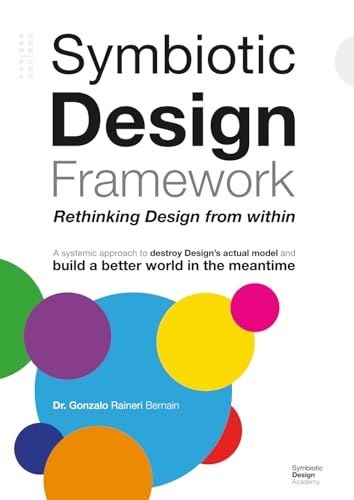
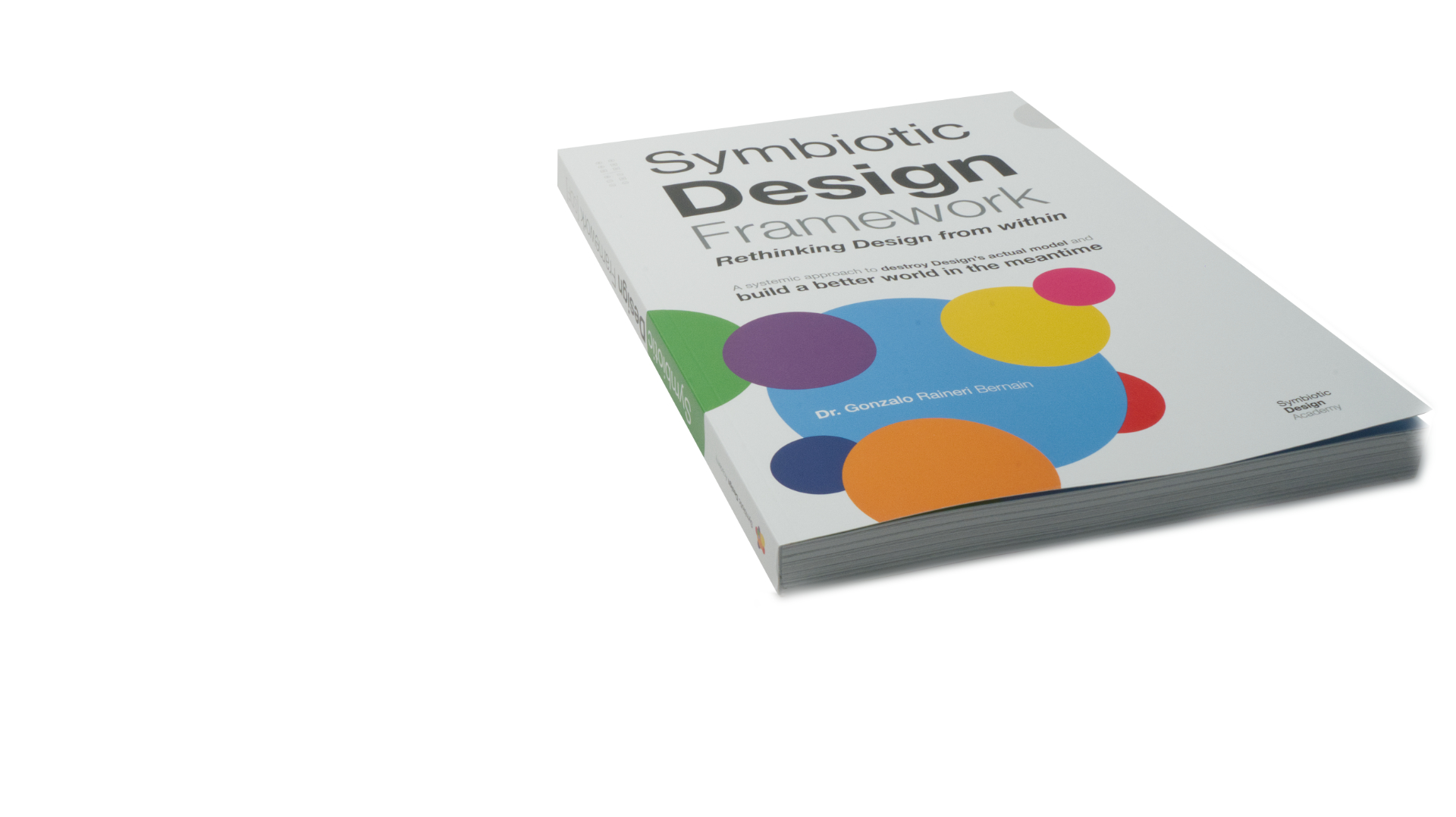
Symbiotic Design Framework
Rethinking Design from within
A book by Dr. Gonzalo Raineri
A systemic approach to destroy Design's actual model and build a better world in the meantime.

Is contemporary design failing us?
In an era defined by cascading crises, from ecological collapse to profound social inequality, prevailing design paradigms often feel inadequate, complicit in the very systems driving unsustainability. Dr. Gonzalo Raineri Bernain's Symbiotic Design Framework offers a radical, theoretically robust alternative for academics, researchers, and advanced practitioners seeking to fundamentally reorient the discipline.
This seminal work introduces a groundbreaking proposition: Design as an autopoietic (self-creating) social system. Drawing rigorously from systems biology (Maturana, Varela), cybernetics, and sociology (Luhmann), Raineri argues that design sustains and evolves itself through its own internal operations. Understanding this self-producing nature is crucial for intervening effectively.
The framework provides a powerful diagnostic and strategic lens built on the biological concept of symbiosis. It moves beyond analyzing isolated components to evaluating the relationships between them. Are they mutualistic, parasitic, commensal? This relational analysis is guided by the framework's non-negotiable ethical core: the “Four Mottos”.
The Four Mottos
Ethics
The foundational pursuit of collective flourishing (Eudaimonia) and justice for all beings, informed by pluriversal perspectives.
Sustainability
An ethical obligation for intergenerational and inter-species equity, demanding regenerative practices.
Social Responsibility
An active commitment to equity, dignity, challenging systemic injustice, and collective liberation.
Economics
Reframed as an ethical pursuit of shared prosperity and fundamental needs fulfillment, rejecting purely extractive models.
Key conceptual tools
- Seven Interdependent Components
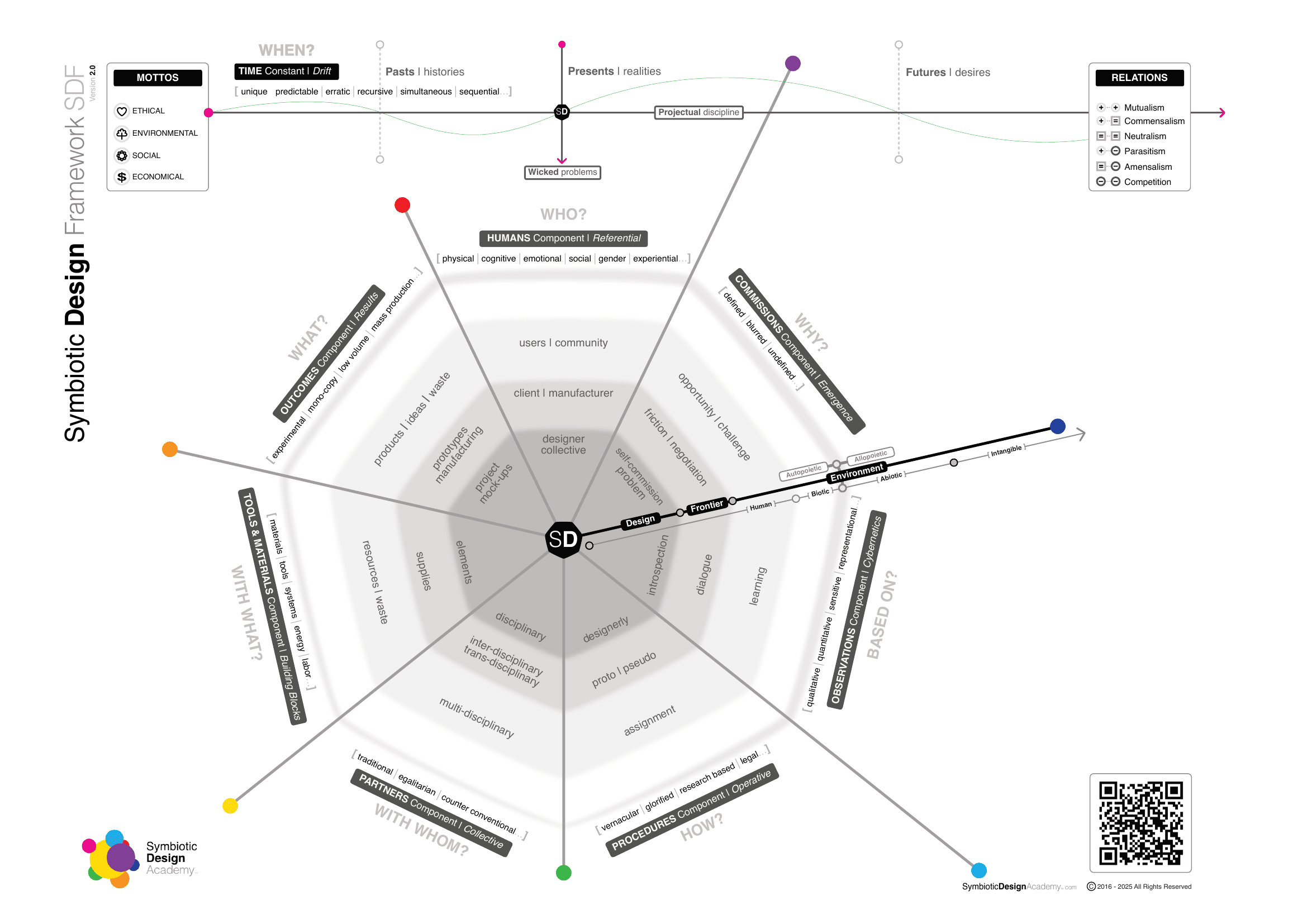
- Humans (Who?), Commissions (Why?), Observations (Based on what?), Procedures (How?), Partners (With whom?), Technology (With what?), Outcomes (What?).
- Three Operational Dimensions
- Mapping activity across the self-producing Core, the interactive Frontier, and the contextual Environment.
- Tame vs. Wicked Problems
- A critical diagnostic for navigating complexity.
- Engagement with Time
- Understanding design's operation within past legacies, present flux, and future responsibilities.
The Symbiotic Design Framework challenges practitioners to move beyond designing mere objects or optimizing flawed systems. It demands a shift towards stewarding living relationships over time, consciously engaging with design as an inherently political act, and actively countering the extractive logics of the Capitalocene. It is a call to embrace complexity, pluriversality, and ethical courage.
Intended for design theorists, doctoral researchers, educators, and high-level practitioners, this book also offers invaluable insights for professionals in systems thinking, sustainability, social innovation, policy, and any field grappling with wicked problems and seeking transformative, ethically grounded approaches. It is not another methodology; it is a fundamental recalibration of the design discipline itself.
Inside the book
231
Terms and Concepts
177
Authors and Thinkers
161
Examples, 35 with images
Editions
All versions have the same content.
Web Experience
Interactive, audio preview available. Instant access for 12 months.
Paperback print
Black and white printed version. ISBN 978-90-836216-3-0.
Paperback print
Full colour printed version. ISBN 978-90-836216-0-9.
Hardcover print
Full colour printed version. ISBN 978-90-836216-2-3.
Purchasing opens here soon. In the meantime, reach out through the contact page.
We only provide print on demand: no stock, no additional pollution.
The book is only available here and is not distributed on other platforms.
Ask your local bookstore, your community or your university library for the book using the ISBN numbers above, and let them know this is the only place it is available. That is the most sustainable solution: a shared book.
Contents
Forging the Foundation
Chapters
[01] Confronting Our Moment
We must confront the inescapable reality of when we are. It is a moment defined not by a vague “Anthropos,” but by the Capitalocene: a specific economic logic built on “Cheap Nature” and fueling extreme carbon inequality, where the richest 1% emit as much as the poorest 5 billion people. We are mired in interconnected “wicked problems”, leaving us at a crossroads: will design remain complicit in this destruction, or will it finally become a force for healing?
- [001] Where Do We Stand in Time?
- [002] Finding Our Footing in the 'Now'
- [003] The Weight and Wisdom of the Past
- [004] The Heart of the Matter: Emotion, Choice, and Why We Design
- [005] Breaking Free: The Hard Work of Questioning Dogma
- [006] Stepping Towards a Symbiotic Future
- [007] Confronting the Anthropocene and Assuming the Capitalocene
- [008] Wrestling with Wickedness: The Tangled Knots of Now
- [009] Flickers of Awakening: Have We Learned the Lessons?
- [010] The Designer's Crossroads: Complicity or Transformation?
- [011] Beyond Techniques: A Shift in What We Value
[02] Navigating Time in Design
We must stop seeing Time as a simple, linear progression; it is the very medium we drift in, an ever-flowing Heraclitean river. This flux reveals design not as a static toolkit, but as a living, autopoietic system, one whose history is deeply complicit in the Capitalocene and the calculated waste of planned obsolescence. Navigating the “wicked problems” of the present demands we embrace this “pluriversal” complexity and understand our knowledge's “Ethnoevolution” to cultivate the temporal wisdom essential for ethical practice.
- [012] The Unavoidable Medium
- [013] The Nature of Time in Design
- [014] Design in Flux
- [015] Engaging the Past
- [016] Navigating the Present
- [017] Projecting the Future
- [018] The Temporal Paradox and Event Types
- [019] Design Ethnoevolution
- [020] Cultivating Temporal Wisdom
[03] Design is a Political Act!
We must confront the unavoidable truth: design is inherently, inescapably political, constantly negotiating power. For too long, our field has been blinded by a “Eurocentric” focus and a “civilized gaze”, necessitating a move towards a “pluriverse” of diverse, autonomous design practices. This means challenging the extractive, colonial mindset perpetuated by neoliberalism and our own complicity in cultural appropriation. The legacy of Chile's Project Cybersyn reminds us that radical, systemic thinking can emerge from urgent local needs.
- [021] Finding Strength in the Local Perspective
- [022] The Search for Your Own North
- [023] Chile's Crossroads
- [024] The Unavoidable Politics of Shaping Futures
- [025] Cybersyn as a Vision of Decentralized Design
- [026] Confronting Our Complicity
- [027] Every Choice Matters
- [028] A Call to Rethink Our Models
- [029] Embracing Local Identity for a Truly Symbiotic Future
[04] From Tame to Wicked
The designer's most critical skill is not execution, but diagnosis. We must abandon the catastrophic pitfall of misapplying cherished methodologies, recognizing the fundamental divide between “tame” and “wicked” problems. Tame problems are solvable puzzles; they can be clearly defined and have unambiguous stopping points. Wicked problems, the true challenges of our time, are intractable systems; they resist definitive formulation, have no stopping rule, and offer no “true-or-false” solutions. Most challenges are “Hybrid”, demanding we become versatile navigators capable of reading this complex terrain.
- [030] From Tame to Wicked Systems
- [031] The Primacy of Diagnosis
- [032] The Problem Spectrum
- [033] Defining Tame Problems
- [034] Design's Historical Blind Spot
- [035] Deconstructing Wicked Problems
- [036] The Core Design Analogy
- [037] Complicated vs. Complex
- [038] Navigating the Terrain
- [039] Navigating a Dynamic System (Wicked Problems)
- [040] Navigating Hybrid Terrain (The Most Common Reality)
- [041] Key Implications for the Symbiotic Designer
Illuminating the Theory
Chapters
[05] A Journey into Systems Theory
The recent surge in systems thinking is not an invention, but a re-discovery of ancient, intuitive wisdom. This holistic grasp of interconnectedness echoes in Greek philosophy, in the Buddhist concept of pratītyasamutpāda (dependent origination), and in the Taoist alignment with natural flow. The 9th-century Borobudur temple stands as a profound masterpiece of systemic design, a 3D mandala guiding a transformative spiritual experience. This ancient wisdom was later formalized in the West through General Systems Theory (von Bertalanffy) and Cybernetics (Wiener), leading us to the crucial “biological turn”: Autopoiesis.
- [042] Unearthing the Systemic Roots
- [043] Echoes of Systemic Thought in Antiquity
- [044] Borobudur as a Systemic Masterpiece
- [045] The Emergence of Formal Systems Thinking
- [046] Pioneers of Systemic Application in Design
- [047] The Biological Turn Towards Autopoiesis
[06] Autopoiesis and the Logic of Self-Production
We must move beyond simplistic models to grasp design's autopoietic heart. The discipline is not its outputs; while artifacts are “allopoietic” (other-produced), the discipline itself is a living, self-producing system. It maintains its identity through “organizational closure” by perpetually regenerating its own knowledge, practitioners, and discourse. This conscious, intentional act of creation, or “heteropoiesis”, is exclusive to humans. This understanding demands we challenge the myth that “everyone can design” and safeguard the professional “Design Core”.
- [048] Design as an Autopoietic System
- [049] Autopoiesis and Allopoiesis Revisited
- [050] Allopoietic Design Artifacts versus the Autopoietic Discipline
- [051] Manifestations of Autopoiesis in Design
- [052] Self-Production
- [053] Knowledge, Methods, and Theories
- [054] Practitioners and Disciplinary Roles
- [055] Discourse and Communication as Generative Forces
- [056] Organizational Closure
- [057] Guiding Distinctions within Design's Operational Logic
- [058] Structural Coupling
- [059] Boundary Maintenance
- [060] Heteropoiesis as the Domain of Intentional Human Design
- [061] Design as the Heteropoietic Action
- [062] Bridging Heteropoietic Acts and Allopoietic Outputs
- [063] Operational Framework: Dimensions, Components, and Variables
- [064] Dimensions: Mapping Design's Operational Space
- [065] Design's Core
- [066] Design's Frontier
- [067] Environment (Ecological Niche)
- [068] Introduction to the Components of the Framework
- [069] Simple and Composite Units
- [070] Components
- [071] The Role of Variables and Guiding Questions within Components
- [072] Honesty
[07] Symbiosis and the Logic of Interdependence
An inventory of parts is useless; we must understand the life that flows between them. Symbiosis provides the essential logic for diagnosing the health of these relationships. We must learn to distinguish Sustainable Relations: Mutualism [+,+], Commensalism [+,=], and the illusion of Neutralism [=,=], from the corrosive Unsustainable Relations. These destructive dynamics include Parasitism [+,-] (like the “kleptoparasitism” of cultural appropriation) and Amensalism [-,=]. The Four Mottos provide the crucial evaluative compass for this diagnosis, with Ethics as the non-negotiable foundation.
- [073] Symbiosis, The Logic of Interdependence
- [074] A Practical Typology for Design Analysis
- [075] Sustainable Relations
- [076] Mutualism [+,+]
- [077] Commensalism [+,=]
- [078] Neutralism [=,=]
- [079] Unsustainable Relations
- [080] Parasitism [+,-]
- [081] Amensalism [-,=]
- [082] Competition [-,-]
- [083] The Evaluative Compass: The Four Mottos as Criteria
- [084] The Dynamic Arrow of Time
- [085] A New Logic for Design
Articulating the Framework
Chapters
[08] The Emergence of the Framework
This framework was not invented in isolation; it gradually emerged through a journey spanning theory, immersive observation, and global dialogue. It began by wrestling with the elusive nature of “design” and “sustainability”, a path that led inexorably to biology and the transformative concept of Autopoiesis. My doctoral research confirmed the hypothesis: design itself operates as a dynamic, self-producing autopoietic system. This theoretical core was then stress-tested in the “living laboratory” of the World Design Capital® Valencia 2022. Finally, it was forged through collaborative dialogue, which integrated the Four Mottos and revealed Time as a fundamental, enveloping constant.
- [086] A Journey Through Inquiry, Observation, and Dialogue
- [087] Design as an Epistemological Object
- [088] The Methodological Journey
- [089] Questioning Design's Foundations
- [090] The Turn to Biology: Discovering Autopoiesis
- [091] The Doctoral Deep Dive
- [092] From Theory to the World Stage: Validation in Valencia
- [093] Collaborative Refinement
[09] The Four Mottos
We can no longer afford the comfortable illusion that design is a neutral tool; it is always world-making. This framework therefore establishes Ethics not as an add-on, but as the foundational cornerstone upon which all else is built. This ethic is defined as the pursuit of collective flourishing, or Eudaimonia, and pragmatically grounded in Manfred Max-Neef's Fundamental Human Needs. This non-negotiable compass guides the interconnected mottos of Sustainability, Social Responsibility, and Economics. This demands we embrace epistemic justice, actively integrating plural perspectives from feminist, Indigenous, decolonial, and intersectional thought.
- [094] Expanding the Vision
- [095] Ethics: The Foundational Cornerstone for Embracing Plurality
- [096] Sustainability: Across Time, Species, and Justice
- [097] Social Responsibility: An Ethical Commitment to Well-being
- [098] Economics: An Ethical Pursuit of Shared Needs Fulfillment
- [099] Towards Conscientious, Liberatory, and Symbiotic Design Practice
Components
Chapters
[10] Humans Component
We must affirm that the Human Component is the absolute cornerstone of design, the referential sine qua non asking “Who?”. Design is not an abstract mechanism but an intrinsically human act, rooted in our unique agency for intentional creation, or heteropoiesis. This component is the very locus where the Four Mottos are enacted through human ethical reasoning. We must analyze this “Who?” across its dimensions: the Core (the Designer and Community), the Frontier (Clients and Manufacturers), and the Environment (the Users and Communities impacted by our work). This requires grappling with the complex variables of human experience: Physical, Cognitive, Emotional, Social, and Gender.
- [100] Referential (Who?)
- [101] Alignment with the Four Mottos
- [102] Autopoietic Significance of the Human Component
- [103] Humans Dimensions
- [104] Core Dimension
- [105] Frontier Dimension
- [106] Environment Dimension
- [107] Variables Influencing the Human Component
- [108] The Influence of Time on the Human Component
[11] Commissions Component
The commission is the crucial moment of emergence, the “Why?” that ignites the design process, transforming latent potential into a call for intervention. It is rarely a static brief but a dynamic question, demanding constant critical inquiry to avoid the trap of brilliantly answering the wrong question. Whether arising externally from market needs or societal crises, or internally from a designer's self-commissioning agency, it frames the challenge. This frame inevitably encounters friction at the frontier, necessitating skillful negotiation. Ultimately, the commission mediates between vision, constraints, and ethical responsibility, demanding we probe the underlying “Why?” through the lens of the Four Mottos.
- [109] Emergence (Why?)
- [110] Alignment with the Four Mottos
- [111] Autopoietic Significance of Commission Component
- [112] Commissions Dimensions
- [113] Core Dimension
- [114] Frontier Dimension
- [115] Environment Dimension
- [116] Variables Influencing the Commission Component
- [117] The Influence of Time on the Commission Component
[12] Observations Component
Observation is not passive reception but an active, cybernetic engagement, the “Based on what?” that grounds design in enacted reality. Embracing a second-order perspective (Maturana & Varela), we recognize that “anything said is said by an observer”; we co-create the world through the distinctions we make. Observation thus becomes a continuous feedback loop (observe, act, reflect), requiring disciplined curiosity and introspection to surface our own biases. We must deploy diverse variables (Quantitative, Qualitative, Sensitive, Representational), often through facilitated dialogue, and engage in systemic learning to move beyond superficiality towards the deep, empathetic understanding necessary for responsible intervention.
- [118] Cybernetics (Based on what?)
- [119] Alignment with the Four Mottos
- [120] Autopoietic Significance of Observations Component
- [121] Observations Dimensions
- [122] Core Dimension
- [123] Frontier Dimension
- [124] Environment Dimension
- [125] Variables Influencing the Observations Component
- [126] The Influence of Time on the Observations Component
[13] Procedures Component
We must recognize procedures as the crucial “How?”, the structured yet adaptable methodologies that translate intention into reality, forming the very engine of execution. This “designerly” craft, evolving through practice and reflection (Design Ethnoevolution), must integrate the Four Mottos into its core. Procedures navigate complexity, balancing structure with the flexibility needed for wicked problems. We must distinguish these rigorous, research-based methods from the superficiality of glorified “Pseudo-Design” and engage respectfully with the deep wisdom embedded in vernacular “Proto-Design”. Ultimately, the choice of procedure is itself a critical design decision, shaping outcomes and reflecting the discipline's autopoietic self-production.
- [127] Operative (How?)
- [128] Alignment with the Four Mottos
- [129] Autopoietic Significance of Procedures Component
- [130] Dimensions
- [131] Core Dimension
- [132] Frontier Dimension
- [133] Environment Dimension
- [134] Variables
- [135] The Influence of Time on the Procedures Component
[14] Partners Component
We cannot address the wicked problems of our era alone; the Partners component (“With Whom?”) embodies design's fundamentally collective nature. This dynamic web of collaboration is the primary channel for design's structural coupling with its environment, fueling its autopoiesis. Choosing partners becomes a significant political act, demanding we move beyond extractive relationships toward genuine co-creation and egalitarian models that honor a pluriverse of knowledge. We must distinguish between disciplinary depth and the necessary integration found in inter- and trans-disciplinary work. Crucially, this requires expanding our view beyond the human, recognizing Nature itself as a mentor, stakeholder, and co-creator.
- [136] Collective (With whom?)
- [137] Alignment with the Four Mottos
- [138] Autopoietic Significance of Partners Component
- [139] Dimensions
- [140] Core Dimension
- [141] Frontier Dimension
- [142] Environment Dimension
- [143] Variables
- [144] The Influence of Time on the Partners Component
[15] Technological Component
We must acknowledge that technology is never neutral; it is the very substrate, the tangible and intangible “With What?”, through which design manifests intent. This co-constitutive relationship shatters the simplistic Aristotelian divide between passive matter and imposed form; materials themselves are “in-formed”, active participants carrying information, demanding a deep literacy and dialogue. While the design discipline sustains itself autopoietically, its outputs (artifacts, interfaces, systems) are fundamentally allopoietic, yet these creations become the vital “words” in the discipline's ongoing self-production. Ultimately, the choice of “With What?” becomes a profound ethical and political act within the Capitalocene, demanding we prioritize regenerative potential over extractive logic.
- [145] Building Blocks (With What?)
- [146] Alignment with the Four Mottos
- [147] Autopoietic Significance of the Technological Component
- [148] Dimensions
- [149] Core Dimension
- [150] Frontier Dimension
- [151] Environment Dimension
- [152] Variables
- [153] The Influence of Time on the Technological Component
[16] Outcomes Component
We deceive ourselves if we view outcomes merely as endpoints; they are the tangible manifestation, the “What?”, embodying the interplay of all preceding components and choices. Critiques like Carson's “Silent Spring” or Leonard's “Story of Stuff” force us to see outcomes not as discrete products, but as powerful agents of systemic change, demanding accountability for their full lifecycle and often-hidden consequences. They serve as the primary measure of a design's success against the Four Mottos, yet also function as critical learning artifacts in an iterative feedback loop. We must be vigilant against the pervasive threat of “greenwashing”, where superficial claims mask a failure to embed genuine ethical and sustainable principles into the very fabric of the outcome.
- [154] Our Creations (What?)
- [155] Alignment with the Four Mottos
- [156] Autopoietic Significance of Outcomes Component
- [157] Dimensions
- [158] Core Dimension
- [159] Frontier Dimension
- [160] Environment Dimension
- [161] Variables
- [162] The Influence of Time on the Outcomes Component
- [163] From Anatomy to Action
The SDF in Action
Chapters
[17] Using the Symbiotic Design Framework
We must understand that the Symbiotic Design Framework is not a method; it is a mindset, a stance. It demands we shift our focus from isolated things to the quality of relationships unfolding over time. Anchored by Time as medium, Environment as active participant, and Symbiosis as analytic, it compels us to cultivate conditions rather than chase control. Using an adapted Bronfenbrenner hierarchy (Micro- to Exosystem) helps scale our relational analysis within the Chronosystem. Practice unfolds through Four Concurrent Events requiring constant vigilance guided by the Four Mottos. This distinguishes the internal Symbiotic Designer from the External Adopter translating the lens to other fields.
- [164] The Symbiotic Mindset
- [165] A Conceptualization of Scale and Hierarchy
- [166] A System of Four Concurrent Events
- [167] Roles in a Collaborative Ecosystem
- [168] A Foundational Distinction
- [169] The Symbiotic Designer
- [170] The External Adopter
- [171] The Collaborative Ecosystem: Essential Partners in Creation
- [172] The SDF in Education
- [173] The SDF in Research
- [174] The Framework in Summation
After the book
This is no Chapter [XX]
This is not a conclusion; it is a handover. The framework demands you adopt a stance: practice epistemic humility, refuse the illusion of one world, engage in real dialogue across difference, and stay with what you change through long-term stewardship. Adhere relentlessly to the ethical compass: Ethics first, then Sustainability, Social Responsibility, and Economics. Treat the relationship as the core unit of design, diagnosing its quality from mutualism to parasitism. Engage the Four Concurrent Events, Situating, Diagnosis, Intervention, Stewardship, not as steps, but as a constant cadence. If you are a Designer, guard this worldview; if an External Adopter, translate faithfully, keeping the ethical spine intact.
A Stance, Not a Method · The Compass · Time as Medium · The Unit: Relationship · Monday's Cadence · To Practitioners · Begin Where You Stand · The Academy · A Closing Ask and a Promise